

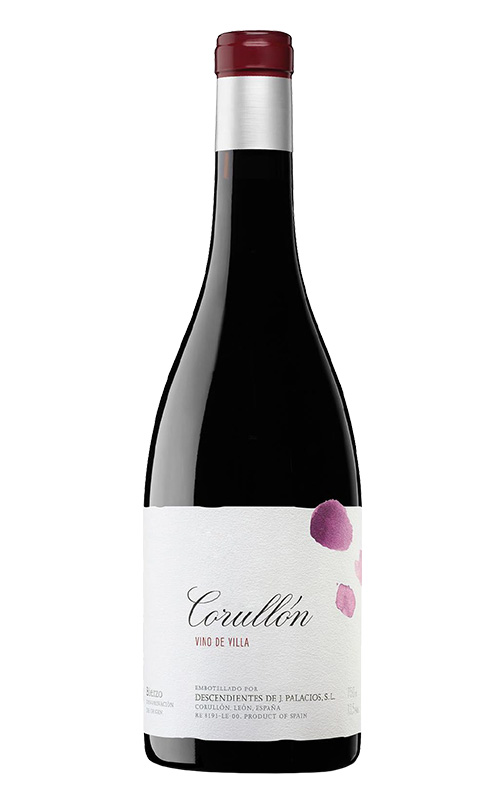
Villa de Corullón 2023
Description
Villa de Corullón est un vin délicat, enveloppant et élégant, issu des coteaux escarpés du Bierzo, d'un paysage qui combine à la fois des influences méditerranéennes et atlantiques et qui confère aux vins leur onctuosité, leur fraîcheur et leur minéralité.
Fiche technique
Dégustation
Vignoble et élaboration
L'avis des experts
The village 2023 Corullón was produced with a selection of 90 plots from the 200+ that they own in the village. It drove me crazy when I tasted it unbottled last year, and it has delivered what it promised. It had an élevage of 9.7 months in barrels, bocoyes and foudres and finished at 13% alcohol with a pH of 3.74. It has a stony, quite Moncerbal-ish (according to Ricardo), serious, austere and a little reductive character, with a flinty and elegant reduction that I love. The vines have been worked organically and biodynamically since they started in 1999, and they achieved organic certification in 2018. The vines are very balanced, and they have learned to manage the warm years much better than in the past (in 2017, they were a lot less ready than today). 2023 was still a warmish year (or at least it's not a textbook Atlantic year), even if the wines, like this Corullón, have a profile that makes you think of a classical year in Bierzo from 20 years ago. It makes me think of the 2001 that I've always liked very much, among my favorite years ever, and also 2021. This is super elegant and fine-boned, one of the finest vintages to date. It's not very fruit-driven and is a little spicy, with weight but ethereal... 34,933 bottles produced. It was bottled in April 2025.
The palate offers sour cherry and redcurrant, with firm tannins for structure. Fruit is drawn from seven vineyards totalling 10.1ha and has up to 10% of white grapes in the blend. Tasted en primeur, Villa de Corullón is still a bit of an awkward teenager, presenting with some reduction on the nose, which Ricardo Pérez Palacios says will disappear with time. It’s definitely a wine to return to in due course.
A very focused vintage with less wood (this is still in oak but the 2022 spent only seven months in barrel) and an increased use of white varieties (around 10% of Palomino, Malvasía and Godello). There’s significant yet seductive reduction but when the fruit is eventually coaxed out of the bottle, it reveals fresh fennel, sotobosque and mint – herbal notes which are typical of the zone and the vintage. The nose offers up pretty rhubarb and sour cherry with delicate rose petal, and leads to a serious palate with a slatey backbone that provides drive and lift. 2025-30

« Descendants de J. Palacios » est un hommage rendu à un père et à un grand-père, respectivement Álvaro Palacios et Ricardo Pérez Palacios, deux figures majeures de l'œnologie espagnole.





Millésimes: 2025 2024 2023 2022
Nos membres n’ont pas encore laissé de commentaires pour ce millésime. Cliquez sur les millésimes précédents pour accéder aux commentaires.
Nos membres n’ont pas encore laissé de commentaires pour ce millésime. Cliquez sur les millésimes précédents pour accéder aux commentaires.
Diferente, pero especial.
Bien.
Vinazo y añadaza!!!
Sin más